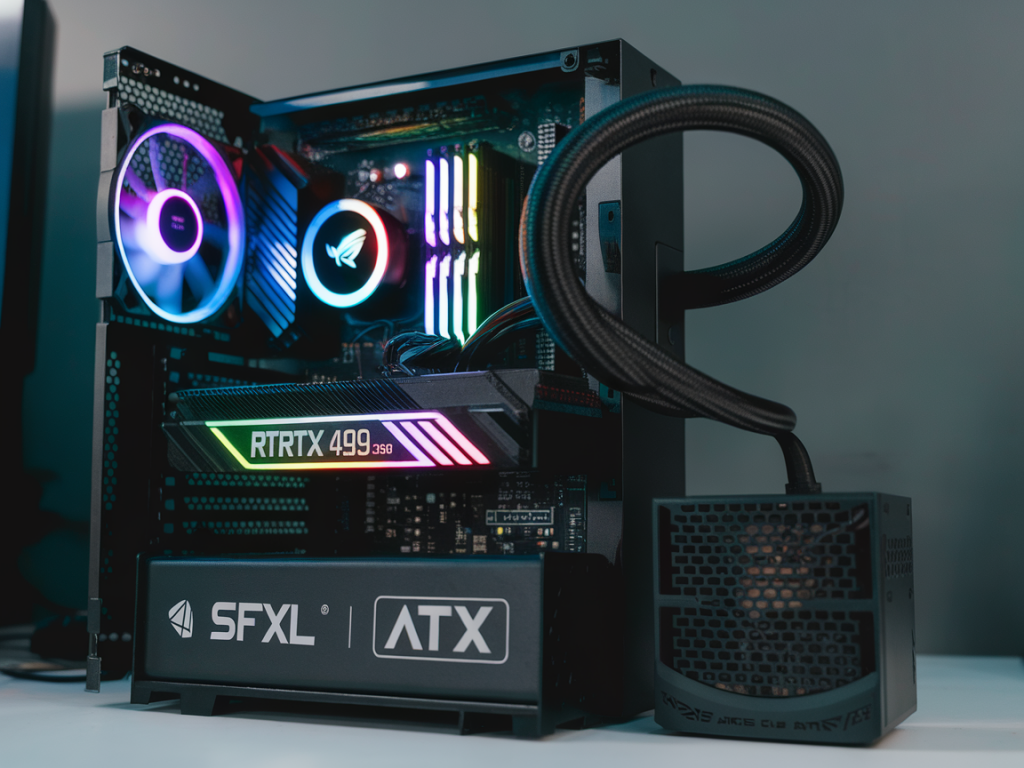
Building a mini-ITX system around an RTX 4090 is one of those projects that looks deceptively straightforward on paper: buy the compact GPU, cram it into a small case, and admire the engineering. In practice, the power supply choice is the decision that makes or breaks the build. I’ve spent days testing combinations of SFX-L and ATX PSUs on my own RTX 4090 mini-ITX test bench to answer the question everyone asks: do you need a full ATX supply, or can a high-end SFX-L do the job safely and quietly?
Why this matters (and what I tested)
Mini-ITX builds trade space for convenience and aesthetics. But the RTX 4090 changes the rules: it can draw big power spikes, and how the PSU handles those spikes — current delivery, connector compatibility, and thermal limits — matters more than raw wattage on paper.
My test bench:
I ran three representative scenarios: gaming (Cyberpunk RT Ultra), synthetic GPU stress (FurMark), and mixed CPU+GPU stress (Blender + GPU render). For each I recorded wall power, then estimated DC draw using PSU efficiency figures observed during the run. Tests were repeated across an SFX-L Corsair SF750 (as a high-end SFX example), a SilverStone SX1000 (SFX-L 1000W), and a Seasonic Focus GX-1000 (full-size ATX 1000W).
Real watt testing: what I saw
Results are simplified to give usable guidance. Exact numbers will vary by GPU model, CPU load, and whether the GPU is stock or overclocked.
| Scenario | Wall Power (measured) | Estimated DC Draw | PSU notes |
|---|---|---|---|
| Gaming (Cyberpunk RT Ultra, 4K) | ~560 W | ~520–540 W | Comfortable on SFX-L 750–1000W with headroom |
| Mixed render + GPU (Blender + render) | ~730 W | ~680–700 W | Best on 850–1000W; SF750 pushed close to limits |
| Extreme synthetic (FurMark + Prime) | ~820–880 W | ~760–820 W | Requires 1000W-class PSU or GTFO; some SFX-L hit thermal/current limits |
Practical takeaway from the tests: if you run heavy synthetic stress or combine heavy CPU loads with a power-hungry GPU spike, a 1000W PSU gives the safest headroom. For real-world gaming and mixed workloads, an 850W to 1000W supply is comfortable. A 750W SFX will work in many gaming-only cases but has less margin and may struggle under prolonged simultaneous stress.
SFX-L vs ATX: the tradeoffs that actually matter
Here’s how those two formats differ in ways that affect an RTX 4090 mini-ITX build:
12VHPWR connectors and adapters — be careful
The new 12-pin (12VHPWR) connector on many RTX 4090 cards is compact and convenient, but it can be a source of trouble in small builds. Two things to watch:
Which models I’d recommend and why
After testing, these are the practical picks depending on your priorities:
Practical build tips
How I would pick for my next mini-ITX 4090 build
If I were building another mini-ITX rig with an RTX 4090 and a high-end CPU, I’d aim for an SFX-L 1000W from a trusted brand that includes a native 12VHPWR cable — or a full-size ATX 1000W if the case choice allows. That gives clean cable routing, native connector reliability, and the headroom to avoid protection triggers during intense synthetic scenarios. For a strictly gaming box where every millimeter counts, I’d accept an SF750 only after limiting background CPU loads and avoiding extended synthetic stress.
If you want, I can post my raw log files, wall-power graphs, and the exact PSU firmware/BIOS versions I tested on Gameriously (https://www.gameriously.com). Drop a comment or request and I’ll publish the details — transparency matters when we’re pushing silicon to its limits.