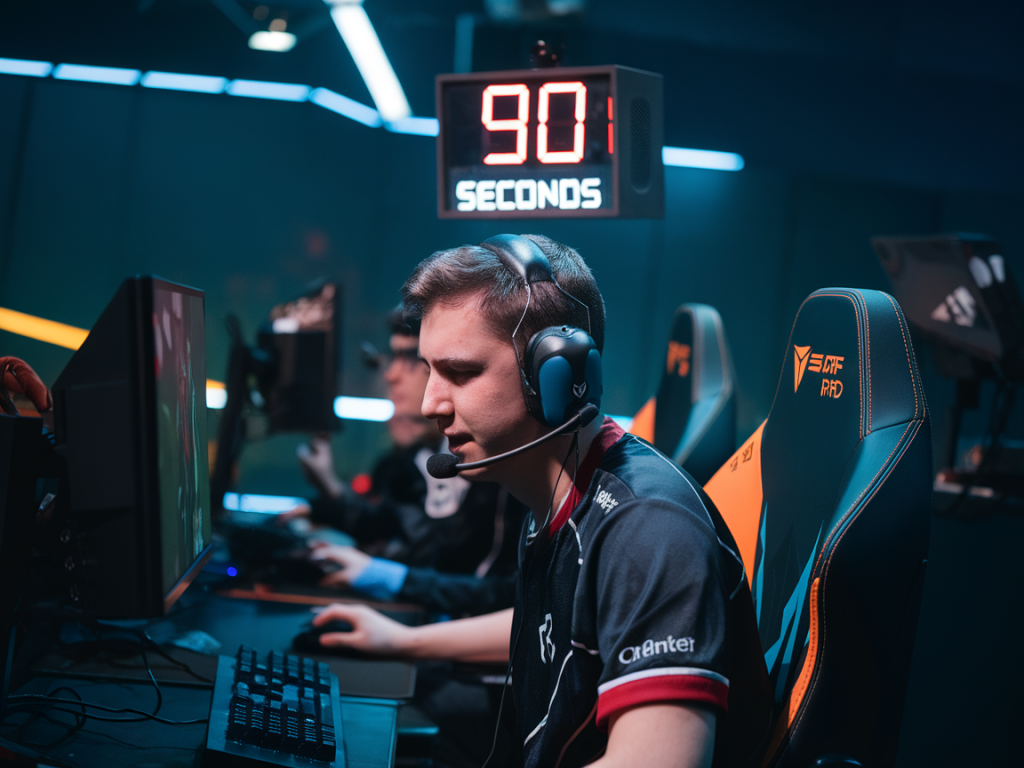
I want to walk you through the exact 90-second comms script that pro teams use to win clutch rounds in 5v5 shooters. I've been on scrim rosters, sat in coach rooms, and tested these scripts live — and what separates good teams from great ones isn't raw aim alone, it's the ability to communicate clearly, quickly, and with purpose when the round is on the line. Below you'll find a time-stamped script, role assignments, example lines, common pitfalls, and practice drills so you can train this with your team and actually win more clutch rounds.
Why a 90-second script?
In most bomb/plant or hostage-style 5v5 rounds, the decisive fight happens inside a short window: final rotate, post-plant, or late-round execute. Ninety seconds covers two key phases — pre-engage setup (the first 45s) and execute/adjust (the last 45s) — giving you a repeatable cadence that reduces chatter and increases impact. Pros use this cadence because it forces prioritized info and synchronized action.
Roles and communication rules
Before you memorize lines, assign roles. Keep it consistent so players know who speaks for what.
- In-game Leader (IGL) — final call on strategy and tempo. Think of this as the round conductor.
- Entry — first contact and space creator. Quick, short confirmations only.
- Support — utility usage and crossfires. Reports on cooldowns and bait setups.
- Lurker/Flanker — silent info gatherer. Should only call concrete info (rotations, kills).
- AWPer/Anchor — long angles and site hold. Calls timings and angle control.
Communication rules:
- One speaker at a time. If you’re not the IGL, prioritize short, factual lines.
- No speculation: “I think” or “maybe” = useless. Only call what you see/hear.
- Use names and locations, not “there” or “they”.
90-second script — the exact lines and timings
Below is the scripted cadence with timestamps relative to the 90-second window. Assume the timer starts at 1:30 (full round) or at post-plant + 90s depending on context. Replace map-specific callouts with your team's agreed names.
| Time | Speaker | What to say (exact script) | Purpose |
|---|---|---|---|
| 1:30 — 1:15 | IGL | "Setup: A-split, smoke B-link, flash mid, hold C connector. Speed: slow-poke." | Define plan & tempo |
| 1:15 — 1:00 | Entry | "Entry ready. Flash in 3." | Confirm readiness |
| 1:00 — 0:50 | Support | "Utility: molly A-box, smoke spawn. I have two flashes." | Resource check |
| 0:50 — 0:40 | Lurker | "Lurker clear: rotated tunnels. No rotate yet." | Enemy rotation info |
| 0:40 — 0:30 | IGL | "Execute in 20. Entry take lane, AWPer hold long. On my count: 3,2,1—go." | Countdown & start |
| 0:30 — 0:15 | Entry/Support | "Flash—entry. Entry: contact at lane. Support: molly box now." | Synchronize fight initiation |
| 0:15 — 0:00 | All | "Planting. Anchor: watch flank. Lurker hold rotate for 10s." | Secure post-plant setup |
| Post-plant 0:00 — 0:40 | IGL | "Post-plant: A site. Default hold: entry near boxes, support off-angle, anchor long. Do not peek alone. Call only dead or location." | Lock defensive positions |
| 0:40 — 0:20 | Entry/Support | "One dead long, two pushing short. They boosted B. Anchor: rotate now?" | Update concrete info |
| 0:20 — 0:00 | IGL | "Delay their pushes: utility on choke at 0:15, delay 0:10. Last 10s: play wide or stack for trade on my call." | Define final defense |
Example in-action script (concrete lines)
Here's how it sounds in a real exchange on a map like "Dustline" or "Ascent" — keep it tight.
- IGL: "Plan A: two mid picks then A-split. Smoke mid-market, flash A-main. Tempo: slow."
- Entry: "I'm ready. Flash in three."
- Support: "I flash entry and molly default box on plant."
- Lurker: "Lurker clear: apartments, no rotate."
- IGL: "Execute in 3, 2, 1 — go."
- (After plant) IGL: "Hold post: site boxes, support up ramp, awper long. Only call kills or exact location."
- Support: "They smoked our site — 2 pushing mid, one taxi."
- IGL: "Delay with nade at 0:15, 0:10. Trade on my call 3...2...1."
Why each line matters
Every phrase is optimized for minimal cognitive load and maximal utility. The initial plan line sets tempo and reduces mid-round opinion battles. Readiness confirmations tell the IGL whether to commit or reset. Utility reports avoid wasted nades or double-molly mistakes. The IGL countdown synchronizes crossfires and reduces engagement variance. Post-plant rigid positioning prevents solo peeks and forces the defenders into predictable windows where trades can be enforced.
Common pitfalls and how to avoid them
- Over-committing information: Players who narrate every step (e.g., "I might push, not sure") create noise. Fix: only call seen/heard facts.
- Talking over the IGL: Causes delays and missed calls. Fix: mute unless role requires it; use push-to-talk and a simple "on me" shorthand.
- No utility awareness: Teams often forget who has smokes/flashes. Fix: one-line resource report at 1:15 mark.
- Absent countdown: Without a synchronized start, entry timings misalign. Fix: adopt the IGL countdown every execute.
Practice drills to ingrain the script
Training this takes repetition. Run these drills in custom lobbies or scrims.
- Silent Round Drill: Only the IGL can speak. IGL must issue full 90-sec script and the team must execute. Purpose: strengthens non-verbal coordination.
- Rapid Call Drill: 10 rounds where only 3-word updates are allowed (e.g., "long dead", "planting A"). Purpose: compress info into essentials.
- Utility Audit: Start scrims with a 60-second utility check. Each player states exact grenades. Purpose: prevents resource surprises.
- Post-plant Freeze: Practice the last 20s defense repeatedly, swapping roles. Purpose: solidifies anchoring and trade positions.
Gear and comm tools that actually help
Good comms are only as good as the hardware and software reliability. I’ve tested headsets and mics extensively; a clear cardioid mic and low-latency VOIP are critical. My go-to picks:
- Headset: SteelSeries Arctis Pro (clear mic and comfortable for long sessions).
- Mic: Shure MV7 for captains who stream and need broadcast-quality voice clarity.
- Platform: Use Discord or TeamSpeak with echo cancellation off in-game sound to avoid confusion. Enable push-to-talk if background noise is a problem.
Use binding keys for quick phrases (in some games you can bind "Planting" or "Flashing" to a key) but never let bindings replace real-time calls in clutch situations.
Troubleshooting when the script breaks
Scripting won't fix everything. If a round devolves, the IGL must call a reset: "Reset to default, one by one, no peeks" — short, decisive, and it immediately reduces chaos. After the round, don't spam blame — run a quick 20-second readout: "What went wrong? One line each." This breeds accountability without flaming.
Practice this script until it becomes second nature: muscle memory in voice works the same as muscle memory on mouse aim. When clutch stakes are high, the team that speaks less but says the right words wins more rounds. If you want, I can tailor this script to a specific map or shooter — tell me the map and your team's role names and I’ll adapt it to your lineup.