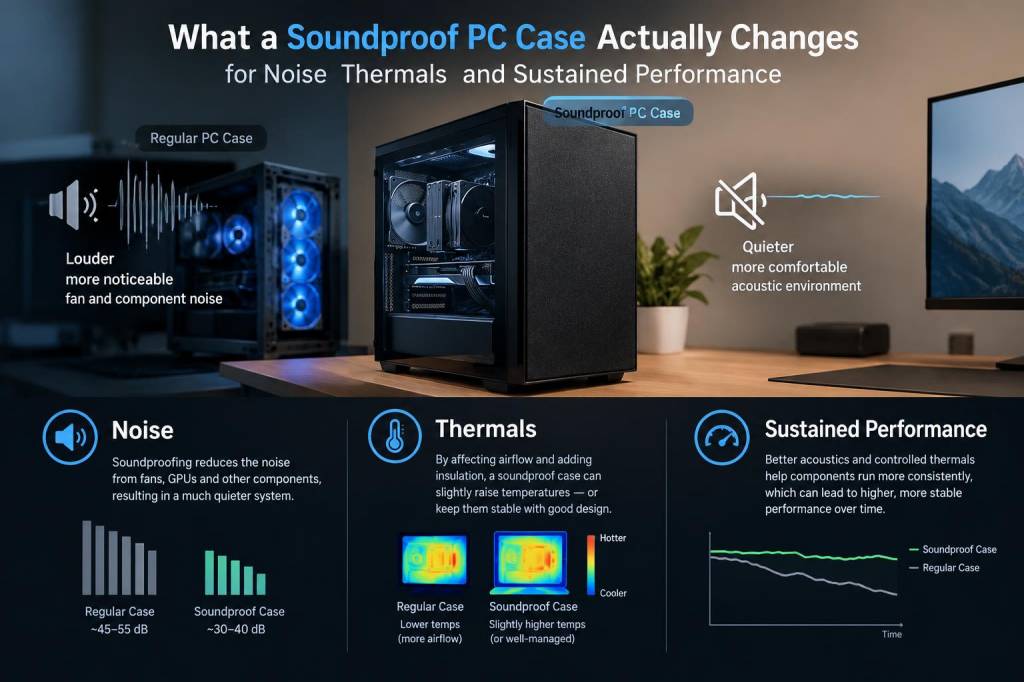
When I first moved a high-power gaming rig into a quieter case, I expected a dramatic transformation. I imagined a machine that would feel almost silent, run noticeably cooler, and somehow hold higher boost clocks forever. What I actually found was more interesting: a soundproof pc case can make a real difference, but not in the magical way many product pages imply. It changes where noise goes, how the system breathes, and how hard fans need to work over time. That affects comfort, temperature balance, and sometimes sustained performance, but only when the rest of the build is set up to cooperate.
What matters most is that a sound-dampened case does not remove noise at the source. It mostly absorbs and blocks sound after it is created. That means your GPU fans, CPU cooler, pump, and case fans still spin, and they still make air move. What changes is how much of that sound escapes into your room and how much of it feels sharp, hollow, or irritating. For me, that difference is especially noticeable during long gaming sessions, when a quiet system helps me focus on audio cues, voice chat, and small details in game worlds without constantly hearing a mechanical drone.
What changes in noise levels
A soundproof pc case usually uses denser side panels, thicker front material, foam or damping layers, and more closed-off airflow paths. In practical terms, it tends to reduce high-frequency fan noise more effectively than low-frequency rumble. That is important because sharp fan whine and coil-related buzz can be more fatiguing than a softer airflow sound. In my experience, a well-designed dampened case can make a midrange build feel much more civilized, especially when compared with a thin steel box that acts like a drum.
Still, a dampened enclosure has limits. If your fans are already loud because they are cheap, poorly tuned, or spinning too fast, a soundproof case will not erase that. It may take the edge off, but you will still hear plenty of airflow if the system is under heavy load. I have also found that case damping can slightly change the character of noise. Instead of a clear, open whoosh, you may hear a more muted hum. For many people, that is a welcome trade.
Here is what I usually notice first:
- Less sharp fan noise at idle and light gaming loads
- Reduced resonance from panel vibration
- Less audible noise when the system sits on or near a desk
- More muffled sound escaping from GPU and front intake areas
That said, sound dampening is only part of a quieter system. Fan curves, cooler choice, GPU model, PSU quality, and even how the case sits on your desk matter just as much. A soundproof case is a tool, not a cure.
What changes in thermals
This is where a lot of buyers get surprised. A soundproof case often improves acoustic comfort by making the chassis more closed, but that same design can make cooling more dependent on airflow planning. A more sealed front panel can restrict intake, and damping material can reduce open vent area. If a case is designed well, that restriction is balanced by larger intake channels, smart vent placement, and enough fan capacity to keep air moving. If it is designed poorly, internal temperatures can climb.
I pay close attention to this because a few degrees can affect fan behavior and boost behavior over long sessions. Modern CPUs and GPUs are very good at protecting themselves, but sustained heat still influences how hard they can boost, how often fans ramp, and how stable clocks remain during extended loads. In a soundproof case, a cooler can sometimes run a little warmer before fan noise becomes noticeable, which is great. But if airflow is too limited, fans may eventually ramp higher than expected to compensate, and that can erase part of the acoustic benefit.
In my own testing, I usually see one of three outcomes:
- Well-designed dampened case: slightly warmer than an open airflow case, but still quiet and stable
- Average dampened case: better noise control at idle, more fan ramp under load, modest thermal rise
- Poorly ventilated dampened case: noticeably higher temperatures and more aggressive fan behavior
That is why I care less about whether a case is labeled “soundproof” and more about whether it has enough intake area, exhaust routing, and fan mount flexibility to support my hardware. A quiet case that traps heat is a compromise I only accept if I know my components can handle it comfortably.
What changes in sustained performance
The phrase “sustained performance” sounds dramatic, but it really comes down to consistency. Can your CPU and GPU hold their boost behavior after fifteen, thirty, or sixty minutes of play? Can fan noise stay controlled while temperatures remain inside a healthy range? A soundproof case influences that balance indirectly.
If the case has good airflow design, sustained performance may improve in a subtle way because the system can maintain a steadier thermal profile without constant fan spikes. That steadiness helps in two ways: first, it keeps temperatures from swinging wildly; second, it can reduce the need for aggressive fan curves that become distracting during long sessions. I have had systems feel smoother simply because they stayed thermally predictable rather than bouncing between cool bursts and noisy corrections.
If airflow is weak, sustained performance can slip. A CPU may begin to sit closer to its thermal limit, a GPU may boost a little less aggressively, and fans may run louder for longer. In severe cases, you can end up with a case that is quieter in short bursts but louder after sustained load because every fan has to work harder to remove trapped heat. That is the opposite of what most buyers want.
In other words, a soundproof case can improve sustained performance only if it preserves enough airflow for your parts. It does not directly make hardware faster. It helps create conditions where your hardware can remain comfortable without audio chaos.
Who benefits most from a soundproof case
I think these cases make the most sense for specific users rather than for every build. If you play in a shared space, record voice, stream, or keep your PC on a desk near your ears, acoustic control can be a huge quality-of-life upgrade. If you run a system with a high-end air cooler, a modest GPU, and a desire for a calm room, damping can feel genuinely premium.
I also think they suit people who value a more restrained look and feel. A closed case often feels cleaner visually, and that matters to me when I want my desk setup to feel intentional rather than loud and busy. On the other hand, if you are building a very hot system with a flagship CPU and GPU, or if you plan to overclock aggressively, I would be more cautious. In that situation, I usually want a chassis with excellent airflow first, then I try to reduce noise through smarter fan selection and tuning.
These are the kinds of users who usually benefit most:
- Players who sit very close to their tower
- Creators who need cleaner microphone audio
- Users with midrange hardware that does not dump extreme heat
- Anyone who prefers a softer, less mechanical room sound
What I check before buying one
When I look at a soundproof case, I do not stop at marketing claims. I check how much of the front panel is actually open, whether top exhaust is restricted, how easy it is to mount extra fans, and whether the layout supports the cooler I plan to use. I also look at panel thickness, internal clearance, and cable routing, because a cramped build can disrupt airflow and create extra vibration.
| Feature | Why I care | What I want to see |
|---|---|---|
| Front intake design | Controls air supply for CPU and GPU | Large vents or hidden side intake channels |
| Damping material | Reduces panel resonance and harsh noise | Dense lining without blocking airflow paths |
| Fan mounting options | Helps tune pressure and exhaust | Flexible front, top, and rear fan support |
| Clearance for coolers | Ensures compatibility with larger hardware | Enough room for tower coolers and thick GPUs |
| Panel fit and build quality | Reduces rattle and vibration | Solid frame, tight tolerances, stable feet |
What I do after installation
Even a good soundproof case needs tuning. I always start by checking fan curves in BIOS or software, because a quiet case rewards patience. I prefer to let fans ramp gradually rather than sharply. I also test with real games instead of only synthetic stress tools, since gaming loads often shift between heavy GPU bursts and lighter scenes. That movement tells me whether the case is truly managing heat or merely surviving a short benchmark.
I listen for three things: fan tone, vibration, and sudden speed changes. If I hear a low hum that stays steady, I usually consider that a win. If I hear pulsing noise or repeated ramping, I know airflow balance still needs work. Sometimes a small adjustment, like changing one intake fan or improving rear exhaust, makes a bigger difference than swapping the entire case.
I also pay attention to room conditions. A case that feels perfectly quiet in winter may run warmer in summer. Dust buildup can also reduce airflow enough to change everything. So even with a dampened chassis, maintenance still matters. I clean filters, check fan blades, and keep an eye on temperatures during longer play sessions.
What people often expect incorrectly
Many buyers assume a soundproof pc case will make a loud system silent. That is not realistic. It can lower the amount of noise reaching your ears, but it cannot hide poor thermal design, noisy hardware, or bad fan tuning. Another common misunderstanding is that more closed always means better. In reality, a case needs a balanced path for intake and exhaust. Without that balance, you may end up trading annoyance for heat.
I also hear people say damping only matters for office machines. I disagree. For gaming, sound control can improve immersion a lot. When a case keeps fan noise from competing with gunfire, dialogue, or ambient music, I feel more connected to what I am playing. That is a real performance gain in a broader sense, even if frame rate does not change.
For me, a soundproof pc case is valuable when it is part of a full system strategy: quiet fans, sensible cooling, clean cable routing, and hardware that does not demand extreme airflow. In that setup, it can transform a machine from merely functional into something much more pleasant to live with every day.