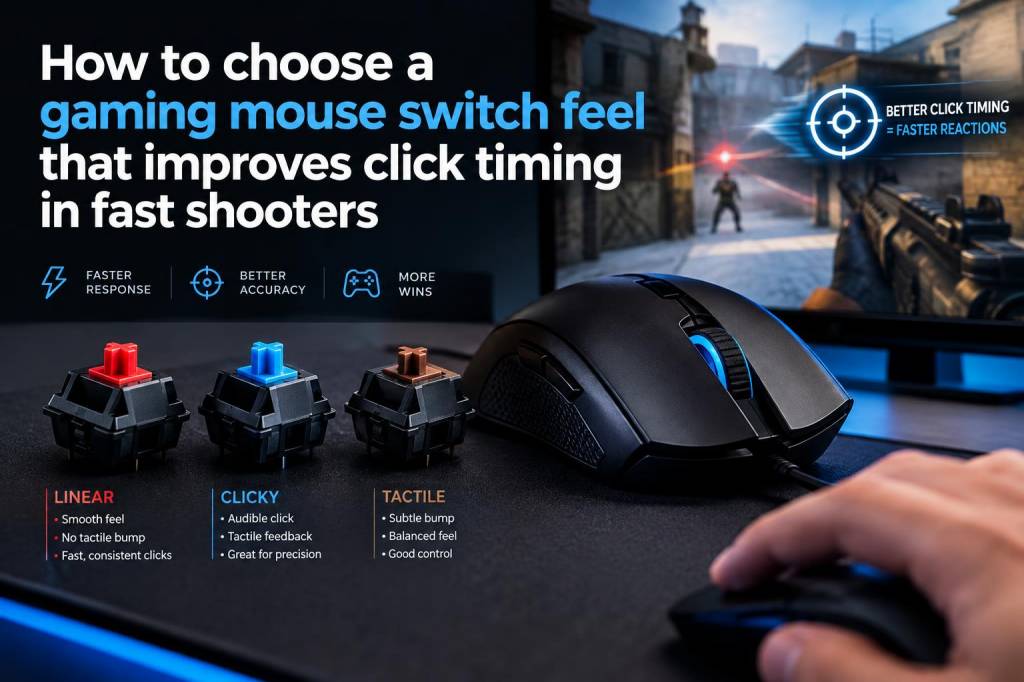
I pay close attention to mouse switches whenever I am trying to improve click timing in fast shooters, because a switch does much more than make a button feel “clicky.” It shapes when my finger receives feedback, how confidently I can repeat shots, and whether my inputs stay clean when a fight gets tense. In a game where a few milliseconds can decide a duel, I do not want a vague button press. I want a switch feel that makes my clicks predictable, responsive, and easy to repeat under pressure.
What switch feel actually changes during aim duels
When I talk about switch feel, I am thinking about several physical traits at once: actuation force, pre-travel, total travel, tactility, and post-travel. These things affect more than comfort. They affect whether I can stop thinking about my mouse and focus on tracking, recoil control, and timing. A lighter switch can help me fire faster if I am using semi-automatic weapons or quick burst patterns, but if it is too light, I may start misclicking during hectic movement or tense peeks. A heavier switch can feel more deliberate and stable, yet it may slow repeated taps if I have to fight the button every time I click.
My own experience has taught me that click timing is not only about raw speed. It is also about consistency. A mouse that feels crisp on the first click but mushy on the next makes timing less reliable. In fast shooters, I want every press to feel similar so my brain can build a rhythm. That rhythm matters a lot when I am tapping heads, juggling burst timing, or trying to time a shot exactly after a strafe stop.
Why actuation force matters more than I expected
Actuation force is one of the first things I test, because it directly changes how much effort my finger needs to trigger a click. In practice, I find that lower force can help me shoot faster with less fatigue during long sessions, especially in games where I click constantly. But low force is not automatically better. If I move my hand aggressively, or if I tense up during clutch moments, a very light switch can turn into accidental firing.
I usually think about actuation force in relation to my play style:
- Light force feels fast and effortless, and it often suits players who value rapid tapping.
- Medium force usually feels balanced, with enough resistance to reduce accidental clicks while still staying quick.
- Heavy force can feel controlled and deliberate, but it may slow repeated shots or increase finger fatigue.
If I am learning a new aim routine or playing a game with lots of tap firing, I usually prefer something in the light-to-medium range. If I am prone to panic clicking, I lean a bit heavier. That tiny shift in resistance can improve my timing because it gives my finger a clearer stopping point and reduces stray presses.
Why click shape matters as much as click speed
A mouse switch is not just about force. It is also about how the click feels when it breaks and resets. Some switches feel sharp and snappy, with a very obvious actuation point. Others feel soft, muted, or slightly dampened. I prefer a switch feel that gives me a clean signal without feeling vague. If I can feel exactly when the input happens, I can build a more reliable rhythm for burst timing and rapid taps.
For fast shooters, I usually look for three things:
- Crisp actuation so I know exactly when the shot registers.
- Short reset so I can fire again without over-lifting my finger.
- Consistent feedback so repeated clicks feel identical during stress.
When a switch has a long, muddy travel, I tend to overthink my timing. I hesitate, release too far, or press too hard. A cleaner feel lets me trust my finger memory more. That trust matters when I am flicking, counter-strafing, and shooting in one fluid sequence.
How I test a mouse switch for fast shooters
I do not trust specs alone. Marketing terms can sound useful, but they rarely tell me how a mouse will behave in real matches. I test switches in a few very specific ways. First, I use them in a training range or aim trainer for repeated taps. I pay attention to whether my finger starts to tire or whether the switch encourages a stable rhythm. Then I use them in live games, because stress changes everything. A switch that feels great in practice may become awkward when I am under pressure and moving fast.
I also watch for accidental double taps or early presses. If a switch is too sensitive for my grip, I may trigger shots without meaning to. If it is too firm, I may delay just enough to miss a window for a clean peek shot. A good switch feel gives me a narrow but comfortable zone where my finger can move quickly without feeling careless.
Another thing I notice is how the switch supports my grip style. When I use fingertip grip, I usually notice switch feel more strongly because my fingers do more of the work. With claw grip, I often like a bit more structure and resistance. With palm grip, I care more about broad comfort, though the click still needs to be precise. There is no universal answer; I match the switch to the way I naturally click.
Popular switch styles and what I notice in play
I have spent enough time with different mice to notice clear personality differences among switch styles. Mechanical switches often deliver a very familiar tactile break, and many players like that classic feel. Optical switches can feel more immediate and can reduce some debounce concerns, which is attractive when I want responsiveness and consistency. The important thing for me is not the label alone, but whether the mouse gives me a reliable actuation point and a satisfying reset.
| Switch feel | What I notice | Effect on fast shooters |
| Light and crisp | Easy presses, quick feedback, low fatigue | Great for rapid taps, but can cause stray clicks if I tense up |
| Balanced and tactile | Clear break, moderate resistance, steady rhythm | Often my favorite for consistent burst timing |
| Firm and controlled | More effort, stronger stopping point, deliberate press | Useful if I want fewer misclicks, though repeated shots may feel slower |
| Soft and muted | Low noise, dampened sensation, less distinct break | Comfortable for long sessions, but sometimes less precise for timing |
Matching switch feel to game demands
I do not use the same switch preference for every shooter. In a tactical shooter, I care a lot about disciplined timing and controlled semi-auto shots, so I prefer a click that feels precise and easy to repeat. In a faster arena shooter, I may lean lighter because I want speed and low fatigue over long stretches of frantic movement. In both cases, I still want a clear reset and no strange resistance changes from click to click.
When I am choosing a mouse, I ask myself a few practical questions:
- Do I fire in short controlled bursts, or do I spam clicks constantly?
- Do I struggle more with missed inputs or accidental inputs?
- Does my hand get tired after long sessions of repeated clicking?
- Do I like a sharp tactile break, or do I prefer a softer feel?
Those answers usually point me toward a switch feel that fits my actual habits instead of a vague ideal. If I spam too much, a firmer click can calm things down. If I miss shots because my clicks feel delayed, a lighter and crisper switch can make a noticeable difference. I like to think of it as tuning the mouse to my nervous system, not just to the game.
Why mouse shape and button tension change the experience
Switch feel never exists alone. Mouse shape, button length, shell flex, and even the way the buttons tilt all influence how a switch feels in my hand. A switch that feels perfect in one mouse can feel completely different in another shell. I have noticed that a mouse with a low, stable button design often makes the click feel sharper, while a more flexible or hollow-feeling shell can make the same switch feel softer or less exact.
That is why I never judge a switch in isolation. I think about how it interacts with my grip and finger placement. If the front of the mouse is too high, my finger may land in a spot that makes the click feel heavier than expected. If the buttons wobble, my timing can feel less trustworthy. I want the mechanical feel, but I also want the shape to support that feel.
When I know a switch is helping my timing
I can usually tell a mouse switch is helping me when I stop thinking about the click. My hand starts moving naturally, my taps become even, and my shooting rhythm feels calm instead of forced. That is the real sign I look for. I am not chasing some abstract idea of “fast.” I want a switch that lets me shoot on rhythm, stay relaxed, and trust each input as it happens.
If I am hesitating before every shot, the switch is probably not matching my preference. If I am clicking too early, the switch may be too light or too vague. If I am feeling solid control and clean repetition, I know I have found something that supports my timing rather than fighting it. That is why I always pay close attention to switch feel when I test a new mouse, because in fast shooters, a small physical detail can change the way I play every single match.
When I compare options, I keep returning to the same idea: the right switch should feel like an extension of my decision-making. It should let me react quickly, click with confidence, and keep my rhythm stable even when the round gets loud and the pressure rises.